
Participation Matrix: Why Reach Alone Isn't Enough
Public participation is often measured by numbers. How many residents attended a meeting? How many people completed a survey? How many comments were submitted?
At first glance, high participation numbers seem like a sign of success. However, participation is about more than simply reaching people. A project can generate hundreds of responses and still fail to provide meaningful insights for decision-making.
A high response rate filled with comments such as "I like this" or "I'm against this" mainly creates noise. You know people are engaged, but you don't know why they feel that way or what they actually need.
On the other hand, imagine five residents spending an hour analyzing their neighborhood and providing detailed improvement suggestions. That is valuable input. Yet with such a small group, it is difficult to claim the feedback represents the wider community.
This creates a dilemma for many participation projects. Should the focus be on reaching as many people as possible, or on collecting meaningful and actionable feedback?
To answer that question, organizations need a way to evaluate both the quantity and quality of participation.
The Participation Matrix: Balancing Reach and Depth
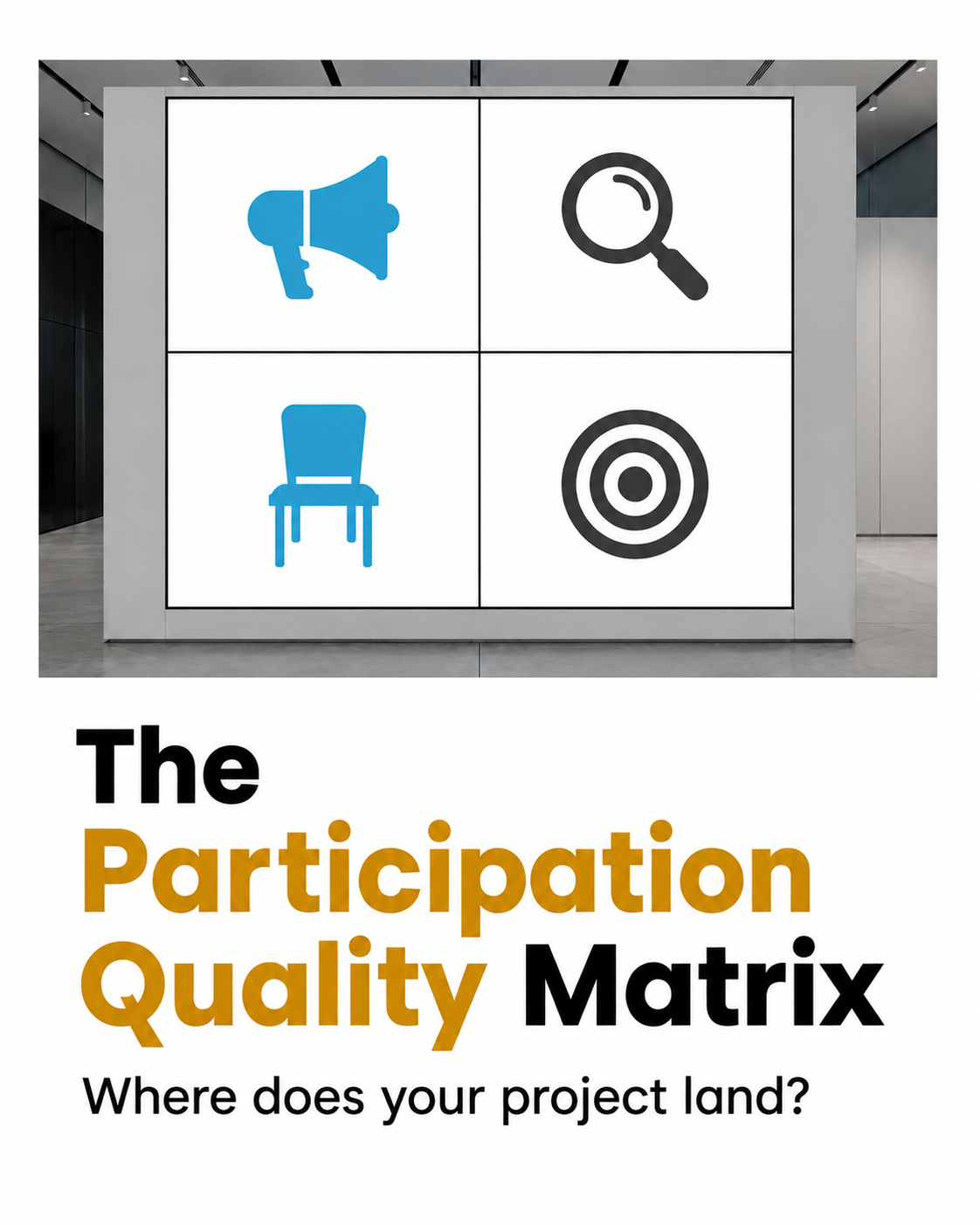
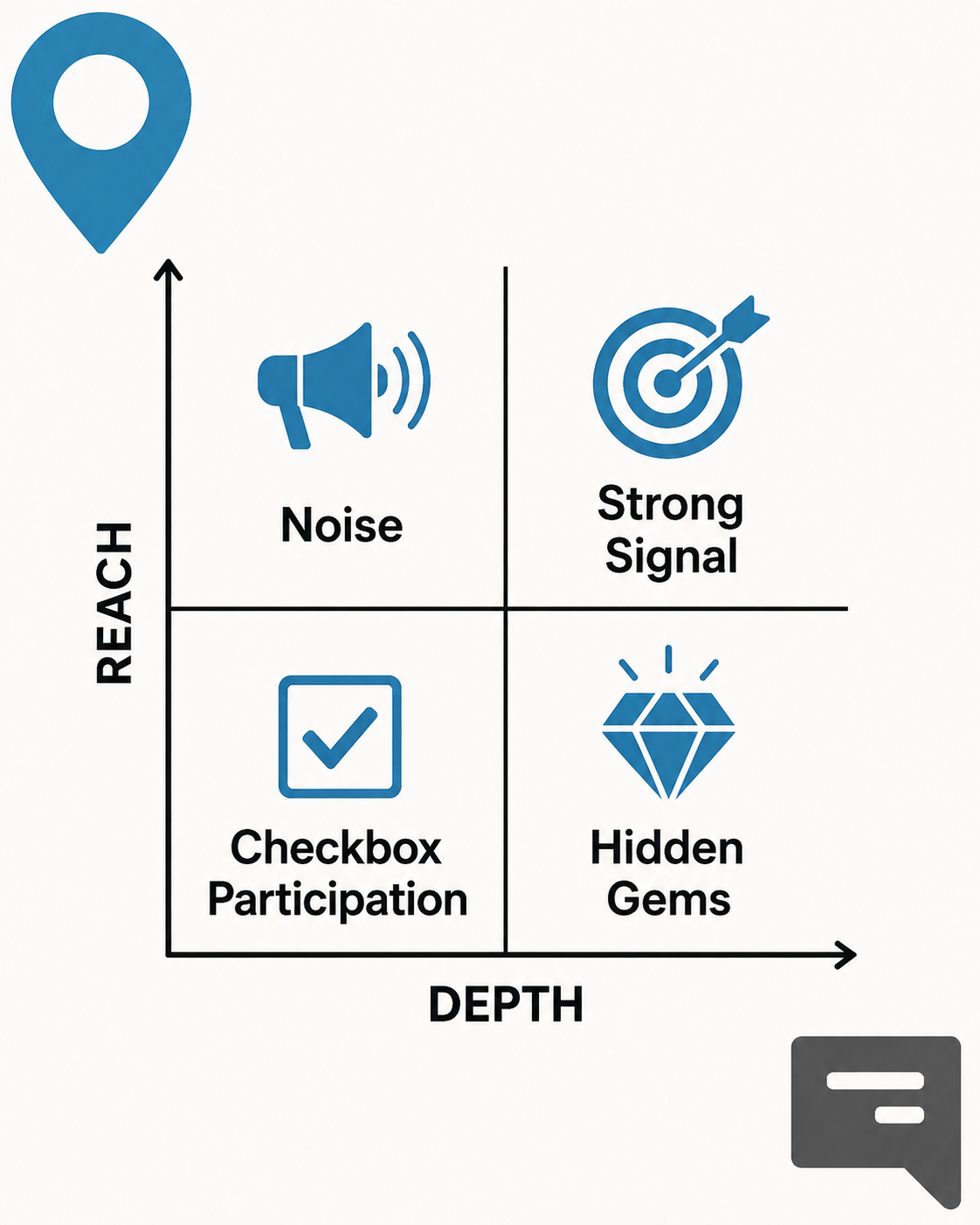
At MapTalk, we use a simple 2×2 matrix that evaluates participation along two dimensions:
Reach: How many people are participating?
Depth: How valuable and actionable is their input?
Together, these dimensions provide a clearer picture of participation quality than participation numbers alone.
The matrix consists of four quadrants.
Tick Boxes (Low Reach, Low Depth)
A small number of people participate and provide only basic yes-or-no responses. The feedback offers little insight and is not representative of the wider community. Many participation projects unintentionally end up here when they rely on closed questions and limited interaction.
Noise (High Reach, Low Depth)
Many people participate, but the feedback remains superficial. Comments such as "Great idea!" or "Don't do it!" demonstrate interest but offer little context. Organizations know people are paying attention, but they lack the information needed to make better decisions.
A Gold Mine Without a Mandate (Low Reach, High Depth)
A small group provides thoughtful, detailed, and highly valuable feedback. Residents share local knowledge, practical suggestions, and well-reasoned opinions. The challenge is that the group remains too small to confidently represent the broader community. Valuable insights are available, but public support remains uncertain.
The Ideal: Representative and Valuable (High Reach, High Depth)
This is where participation delivers the greatest value. A large and diverse audience contributes meaningful, well-supported input. Decision-makers gain both representative feedback and actionable insights that can directly improve projects, policies, and plans.
For most organizations, this is the ideal participation outcome.
How to Move Towards Better Participation
The participation matrix is not just a measurement tool. It helps organizations identify opportunities to improve participation processes and collect better input.
Three factors often make the biggest difference.
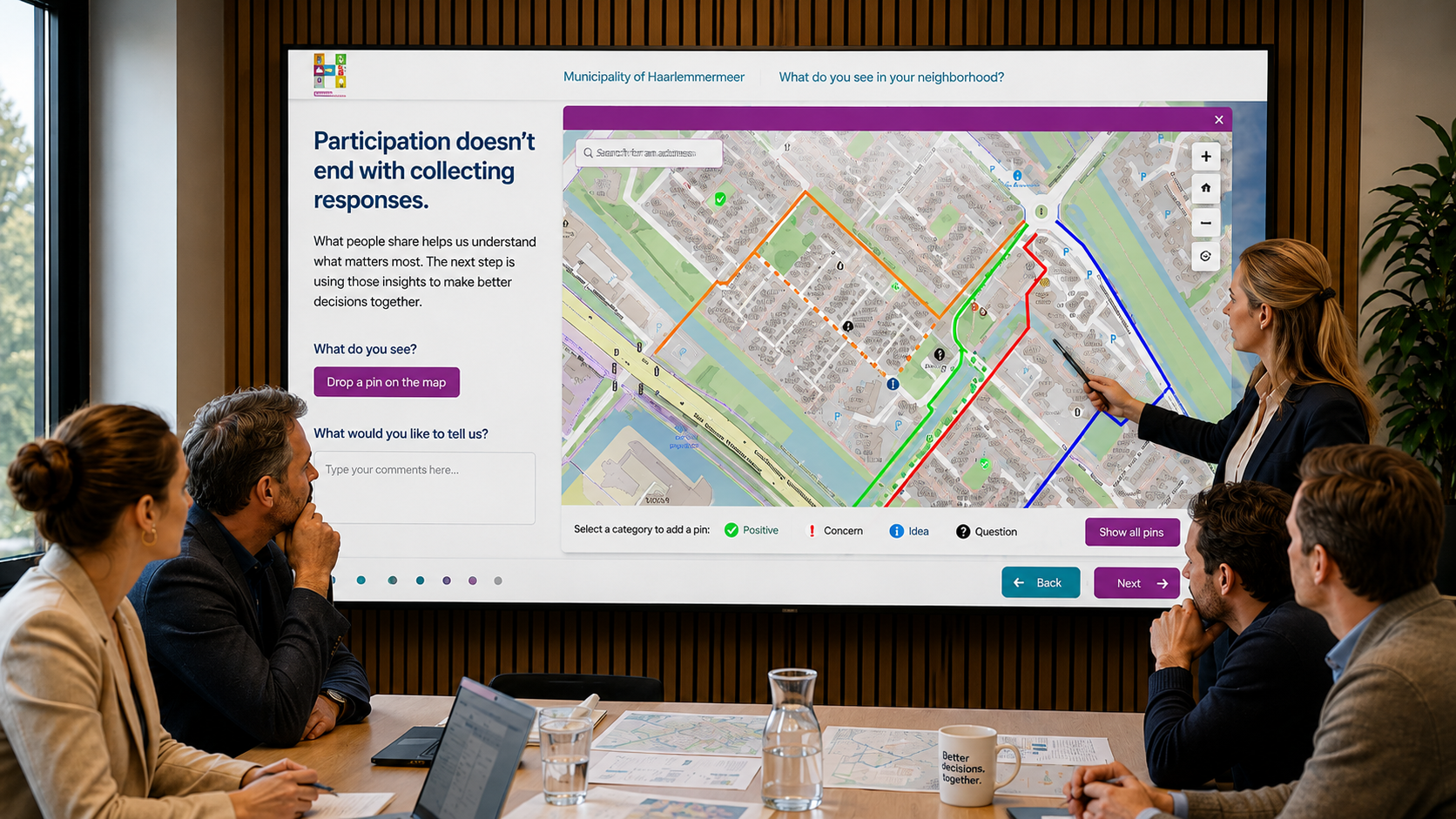
First, make participation as accessible as possible. Tools such as map-based surveys allow residents to quickly indicate locations, concerns, and opportunities. Lowering barriers encourages more people to participate and improves reach.
Second, ask better questions. Instead of only asking "What do you think?", ask questions such as "Why do you think that?" or "What would you do differently?". Meaningful participation starts with meaningful questions, and deeper questions often generate more useful feedback.
Third, combine online and offline participation methods. Digital participation helps reach a broader audience, while workshops, discussions, and in-person sessions often generate richer conversations. Together, they create a balance between scale and depth.
The participation matrix should not be seen as an end goal, but as a diagnostic tool. If a project falls into the "Noise" quadrant, it may be time to ask deeper questions. If it sits in the "Gold Mine Without a Mandate" quadrant, broader outreach may be needed.
When organizations reach the ideal quadrant, they gain more than participation statistics. They gain representative, actionable insights that lead to better decisions, stronger community support, and more successful outcomes.
The real objective is not simply to measure participation. The objective is to create participation processes that help communities, stakeholders, and decision-makers work together more effectively.
Want to discover how map-based participation can help you achieve both reach and depth?